Sunday, May 10, 2015

Market definition in Buyer Power cases

3 weeks ago I had the privilege to be invited as one of the paper discussants of the 1st BECCLE Competition Policy Conference organized in Bergen.

The Conference was a great success for BECCLE and all my recognition to my fellow co-workers that were part of the orginazing team (I was not one of them). Not only it gather a truly remarkable group of keynote speakers, but also the papers presented by PhD candidates and young post-doc were of high quality.

The event took place at the Norwegian School of Economics, just outside Bergen
©
 NHH
In this conference I presented my views concerning market definition for buyer power cases. In a nutshell my (quite long paper) analyze market definition and market power assessment as two fundamental steps carried out by competition authorities – and later on reviewed by courts – whenever dealing with alleged breaches of competition law by undertakings. They are, however, mostly centered in selling side cases. This paper puts forward that a mere reverse of the standard methodologies employed for selling side cases are insufficient for the application in buyer side cases. Thus, it is necessary reassessing the current techniques and their application to be applied to buyer power cases. I submit that in all buyer power cases the market definition ought to be made in both the upstream market and downstream market by adopting a dualistic market definition in buyer power cases. Particular attention ought to be paid to the circumstance of whether the undertaking has market power in the downstream market as this will directly affect whether the conduct is anticompetitive or not. Lastly, this dualistic definition is justified as it fully captures the competitive effects of monopsony or bargaining power and allows for a proper appreciation of buyer power’s welfare effects from a consumer’s perspective.

The working paper I presented is available at: http://papers.ssrn.com/sol3/papers.cfm?abstract_id=2600471

I will be presenting a reviewed version of this paper on May 28-29th in the upcoming Annual Workshop of the Competition Law and Economics Network organized by TILEC in Tilburg, The Netherlands.

Please let me know of your comments/suggestions regarding my paper on market definition in buyer power cases!

Saturday, April 18, 2015

Competition and Buyer Power through an Ordoliberal lens makes top two ten!

Thanks to all of you, my paper on “Competition and Buyer Power through an Ordoliberal lens” has reached in the last two weeks the two top ten lists of most read/download papers of the two categories it has been classified by SSRN: Regulation (European) and Competition Law (European). This is a great source of satisfaction, proud and at the same time thankfulness to those of you interested in my research.

If you have not yet read the paper and want to find out what Ordoliberalism is all about, have a look at it.


Have a good weekend!

Sunday, April 5, 2015

Visiting the EFTA Court

For the next 3 weeks I will be in Luxembourg doing a research visit to the EFTA Court to learn more about EEA law and get some literature related to competition law and public procurement. This is an opportunity that I am looking forward to and that I have been very lucky to get!

The EFTA Court is the little brother of the ECJ. This body has jurisdiction with regard to EFTA States which are parties to the EEA Agreement: Iceland, Lichtenstein and Norway. Nope, Switzerland who is part of the EFTA Agreement is not under the scrutiny of the EFTA Court (very odd but not a surprise when it comes to Switzerland and its peculiar relation with European Integration).

The Court has competence to deal with breaches of the EEA Agreement (basically an extension of the internal market fundamental freedoms) by rendering Judgments determining breaches of EEA law, advisory opinions for national courts dealing with EEA matters and deciding appeals from the EFTA Surveillance Authority (the parallel of the EU Commission).

In relation to my research there have been very few cases in the sphere EEA law that had dealt with buyer power. The notable exception is the Norwegian Color Line case (case no 59120). Apart from this case I have not found any other one in which buyer power has been an important element of a decision and/or Judgment so far. If you know of any, do let me know!

This picture was taken, literally, next to the Faculty of Law of the UiB!
Copyright: Uwe Kahl and found at http://www.panoramio.com/photo/72429
I have managed to do a bit of sightseeing so far as well and… Luxembourg is an odd city! Not only the city itself is built in an interesting and unusual way (in layers and filled with elevators/bridges/hills/cliffs) but also I am always confused what language to use: German, French, Luxembourgish… English? You never know what the other person will speak. Has been fun and interesting. Also the languages issues serve as somehow “market sharing”. Look at this pictures of these 2 fast-food restaurants. They are next to each other (literally)… do you notice something about the languages they use to attract clients?!


I am looking forward to these next weeks to learn more about EEA law and write a lot for my dissertation.


Until soon!

Tuesday, March 24, 2015

Competition and ordoliberalism

As a result of my fruitful and interesting research stay at the University of Freiburg and the Walter Eucken Institute I have been working on a paper entitled "Competition and Buyer Power through an Ordoliberal Lens". 

The paper submits that Ordoliberalism is a German school of economic thought that advocates regulating the free market economic based on a set of state imposed rules guaranteed by the economic constitution to impose a competitive order in society. It proposes an alternative method to pure laissez-faire and state planned economy for the better regulation of the market economy by having as goals the protection of the competitive process and individual freedom. In this article I submit that ordoliberalism, an indigenous European competition policy, is an adequate economic and analytical tool to base the practice and decision making of competition law and, in particular, for the regulation of buyer power. My aim is twofold: contribute to the discussion on what ordoliberalism is in general and in particular concerning competition policy, and offer a new perspective on an ordoliberal-oriented competition policy for the treatment of buyer power.

If you are interested in reading it, you can find the current version available at: http://papers.ssrn.com/sol3/papers.cfm?abstract_id=2579308


If you have any comments/suggestions, I will be very happy to receive them!

Sunday, January 4, 2015

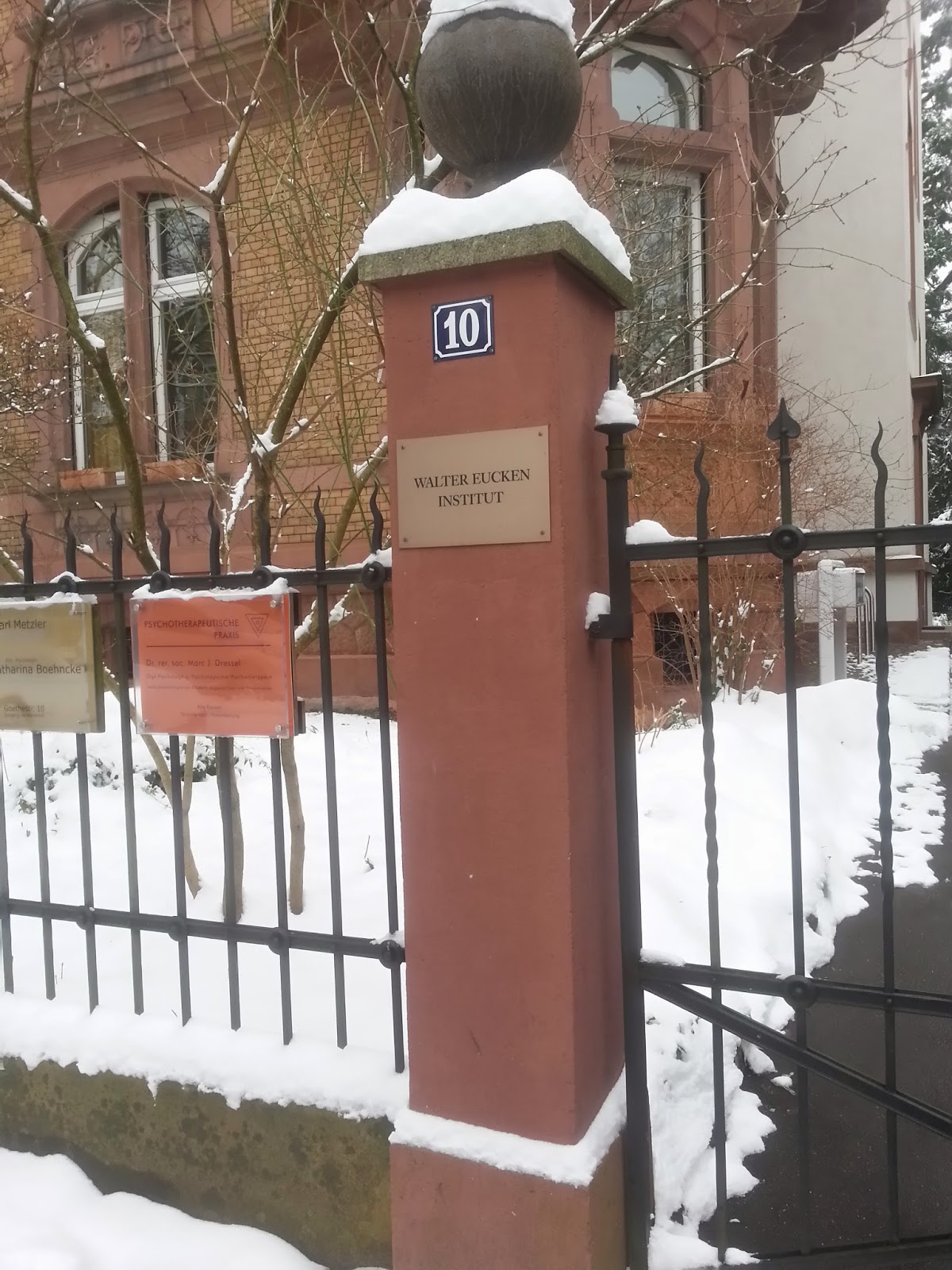
Visiting the Walter Eucken Institut: Ordoliberalism

Since early November 2014 I have had the opportunity to visit the Walter Eucken Institut to do research on the Freiburg School of Law and Economics: Ordoliberalism.

Ordoliberalism – also known as German Neo-Liberalism - is a school of economic (and legal) thought that was born in Germany in the decade of 1930 and influenced its economic development after the WWII. This was partially carried out due to the influence of first Minister of Economy and then Chancellor Erhard, who proposed following ordoliberal ideas as the basis for the “German Economic Miracle” and the concept of Social Market Economy. 


Ordoliberalism proposes a third way between, on the one hand, traditional liberalism and absolute market freedom and, on the other hand, state planned economy. To do, it suggest adopting a set of (legal) rules that will guide the economic behavior of individuals in the market to produce an outcome close to the economic ideal. This set of rules will foster individual economic freedom, growth and stability. For ordoliberalism the competitive process should be guiding mechanism of economic exchanges. Because of this, proper competition should be protected be preventing undertakings from "cheating the rules" economic efficiency follows. Consequently, it is the role of the state to set the rules and ensure that economic parties comply with them by acting as an investigator and judge. The state, thus, acts as a “market police”, through the competition authority, to ensure the respect of competition law.

Ordoliberalism is of great interest to me because I employ this economic theory to develop an analytical framework to discuss what ought to be the regulation of buyer power in EU competition and public procurement law. Not only do I agree in a personal level with many of its postulates, but also because ordoliberalism proposes limiting market power from both the public and private sector in a holistic manner, which serves my purpose of regulating buyer power in both public and private markets.

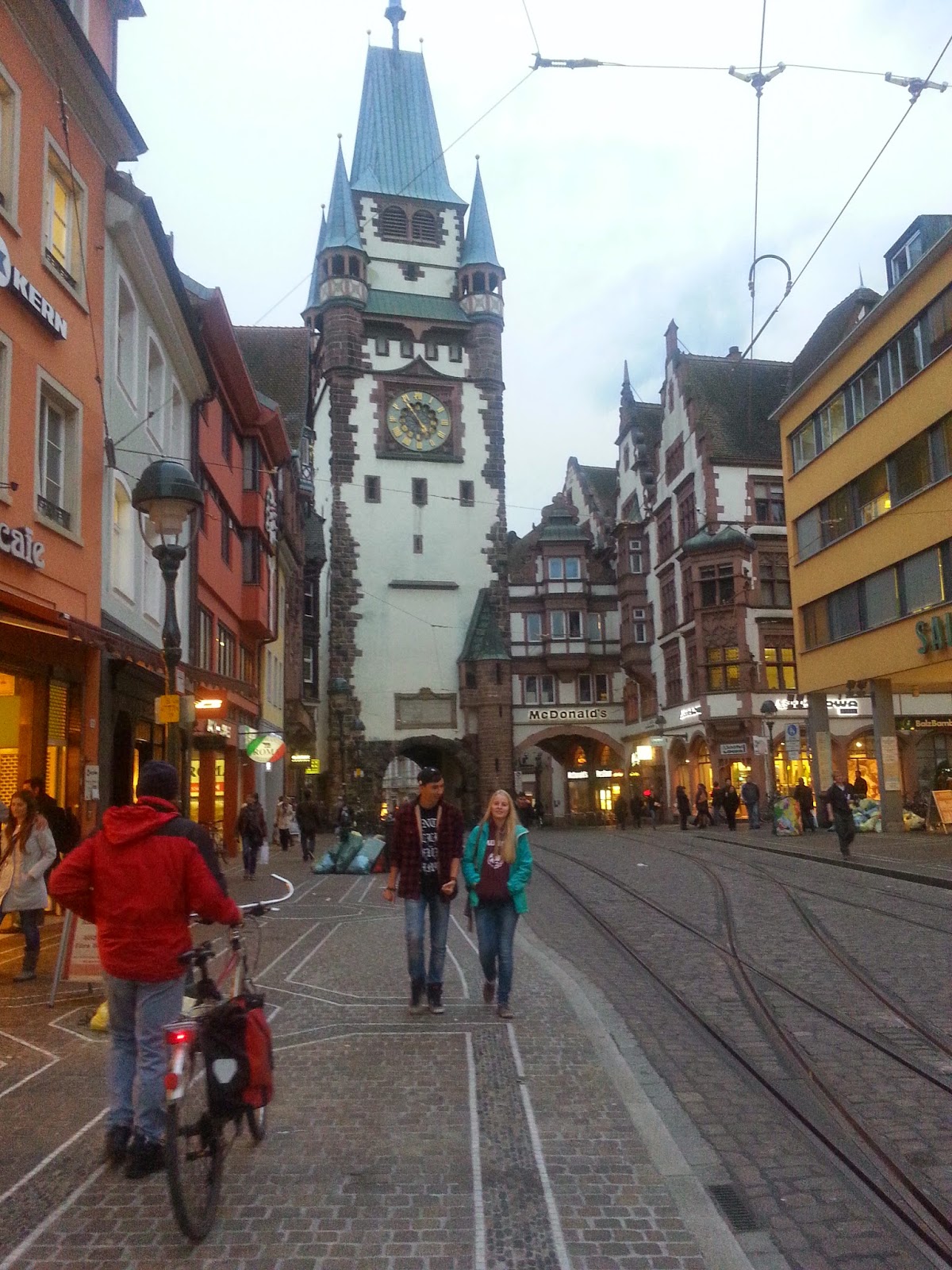
In these already 2 months I have been in Freiburg I have been able to familiarize with this trend of economic thought, reflect on it and understand what implications it has for the regulation of buyer power in competition law. It has been a fascinating task that transported me from the world of competition law and competition microeconomics to a broader level of speech in macroeconomics and constitutional economics (the ordoliberals, at least the founding fathers, were/are not microeconomists). Also, not only I have been able to live in Freiburg (a nice university city) but also meet friendly, interesting and very well prepared scholars. To all the team at the Walter Eucken Institut: Vielen Dank!


If you are interested to know a bit more about my stand on ordoliberalism and buyer power, do contact me by email!

Sunday, December 28, 2014

EU/EEA Public Procurement Law at the UiB

At the University of Bergen (“UiB”) we are also teaching EU and EEA public procurement law. For the first time in more than four years, our Faculty of Law offered a course that was mainly targeted to exchange students but also to Norwegian students. This course was firstly offered in the Spring Semester 2014 and due to its success, it was re-offered in the Autumn Semester 2014. As it currently looks, the course will continue in the Autumn of 2015 as well.

Photo: 
Emil Breistein
In our course we explore the most relevant aspects of EU/EEA public procurement law. Our classes mainly deal with the Public Sector Directive but we also cover, succinctly, some relevant aspects of the Utilities and new Concessions Directive. We do so by discussing the 2004 and 2014 Directives as we want to offer students with the present and the future of public procurement. For an overview of the lectures, reading materials and exam modalities, see the link to our course at: http://www.uib.no/en/course/JUS285-2-A

I have the pleasure to lecture the course with a group of very qualified and fantastic people at the UiB and even abroad. We are a group of four lecturers covering 11 sessions and touching topics not only related to public procurement but other areas of the law, such as competition law and state aid. The lecturers this year were: Ms. Linda Midtun; Ms. Malgorzata Cyndecka and Mr. Anders Thue. It has been a great experience working with all of them!

Also, the course helped organizing an international seminar discussing the interrelation between public procurement and competition law. You can watch the recording of the seminar at: http://beccle.no/beccle-seminar-the-interaction-between-eueea-public-procurement-and-competition-law/

Lastly, our team was kindly invited to participate at the Annual Seminar of the Norwegian Complaints Board for Public Procurement (KOFA) and we look forward to strenghtening our ties with them for future joint activities.

All in all, if you are looking for a course on EU/EEA public procurement law and related activities now you know where to go!

Looking forward to seeing you in Bergen!
Photo: 
Paul S. Amundsen


Sunday, December 21, 2014

Some publications already out in 2014 and coming as well in 2015!

On the latest issue of the Public Procurement Law Review I published an analysis of the EFTA-Court Judgment E-24/13 Casino Admiral AG v Wolfgang Egger.
This case analysis reviews the treatment given by the EFTA Court to the breaches to the obligation of transparency when awarding public concession contracts. Also, the paper analyses what would be the outcome of a similar case with the entry into force of Directive 2014/23/EU on the award of concession contracts. For further details, see:
Ignacio Herrera Anchustegui, EFTA Court case E-24/13 Casino Admiral AG v Wolfgang Egger: the obligation of transparency and consequences of its breach when awarding service concessions, The Public Procurement Law Review, 2015 (1), pgs. NA1-NA9.
* * * * *
Also, I had the pleasure of writing with Albert Sánchez Graells, senior lecturer in commercial law at the University of Leicester,  a working paper on the new rules on centralisation and occasional procurement under articles 37-39 of Directive 2014/24.
The paper assesses the risks, rationale and justification for the rules on centralisation and aggregation of public procurement in Directive 2014/24. The paper is entitled “Impact of public procurement aggregation on competition. Risks, rationale and justification for the rules in Directive 2014/24″ and is now part of the University of Leicester School of Law Research Paper Series.
The paper explores the justifications advanced for the aggregation of purchasing and the countervailing risks it generates. In both cases, it focusses in economic and administrative aspects. It then proceeds to a summary overview of the new rules for the aggregation of public procurement in Directive 2014/24, and emphasised how the Directive is expressly recognising possibilities that clearly exceed the more modest approach in Directive 2004/18. Moving on, it then focusses on the potential justification for certain activities now permitted by the 2014 rules, and engages in a critical assessment of their competitive impact. The paper briefly highlights the far-reaching and not necessarily positive implications that a maximisation of the centralisation and aggregation possibilities under Directive 2014/24 could have, and proposes that strict competition law enforcement will be necessary to avoid undesired consequences. Some suggestions for further research are provided by way of conclusions.
The full paper is available for download on SSRN. Its full citation is:
Sánchez Graells, Albert and Herrera Anchustegui, Ignacio, Impact of Public Procurement Aggregation on Competition. Risks, Rationale and Justification for the Rules in Directive 2014/24 (December 5, 2014). University of Leicester School of Law Research Paper No. 14-35. Available at SSRN:http://ssrn.com/abstract=2534496.
This post was originally posted on Albert Sánchez Graells’ blog “How to Crack a Nut“ at http://howtocrackanut.blogspot.no/2014/12/paper-on-centralisation-of-procurement.html.

Updating and getting ready for 2015!

After more than a while, I am coming back to the blog and have the intention to make this website live, interesting and updated concerning the relevant buyer power developments on EU and EEA competition and public procurement law.

To all you readers, old (if there is any left!) and new:

Image taken from: http://www.norwayhouse.org/2011/12/happy-holidays-from-norway-house/

Monday, July 29, 2013

Norwegian summer: Livet på hytta

Finally summer came to Norway, a bit late, but it was worthy. I got caught by surprise when I experienced about +30°C this past week. It was warm (way too warm I would even dare to say), sunny and beautiful. But a summer in Norway is not a summer if you don’t go to the family’s cabin or to the boat (or both, if you can!).

I had the chance to get lost this year in the middle of the hills of Telemark for 3 days, going back to the past with no Internet access and no desire for it. They were fantastic days eating grilled food, going on short hikes and reading about competition and public procurement law.

I got lost somewhere over the B letter!

The life at the cabin consist on waking up bitten all over by the mosquitoes and fetching the water from the well to clean the dishes used last night and clean your food. Then you have a healthy and summerish breakfast (some fruit, juices and something sweet because, well, you are in a vacation). Then you go for a walk or take pictures or both! At least that is what we did. After the sun is high up and the temperature reaches an incredible +44°C out of the shadow you sit down and prepare a Norwegian BBQ: pølse, tomatoes and paprika grilled (I doubt the tomatoes or the paprika is Norwegian, but I love them). It is time to eat and enjoy of the sun.


As the day is approaching its end you remember that you have spent about 14 hours without contact to either Internet or any electronic device and it is both surprising as refreshing. Being unplugged was what I needed for a few days. It gives you time to THINK, something I have realized modern life does not allow me to do. I read, see, talk, interact, but have less time (or perhaps I am not aware of how important it is for a PhD student) to think.

To wrap this entry: summer in Norway is amazing, even though if it lasts about 2 weeks!


Monday, July 15, 2013

An abstract of my research project: or what Monopsony is.


Almost 10 months later after I started my "Norwegian adventure" I can say that things are still going the right way. I love the city of Bergen, always rainy, cold summers (freezing cold), very green and flowery. The food in general terms is excellent (particularly the fish), I have learnt how to prepare sushi and Gordon Ramsay has become my best friend.


"Summer time" in Bergen, eh?


Also I have met a great group of people, colleagues, new friends, and even cats! Soon a cat will be moving in to our flat, so that I am a bit scared of how that will turn out, but also looking forward to it. And more importantly, the research project is going well on its way.

Who will win the battle? She or me?

The research project


Anyway, back on track, I have been working this past weekend on writing a one page abstract on my research project and here it is:


Title: “The Regulation of Monopsony and Buyer Power of contracting authorities subject to Public Procurement Law of the EU and EEA”.
Author: Ignacio Herrera-Anchustegui
Institution: University of Bergen-BECCLE

ABSTRACT

This research project analyzes the concept, economic consequences and legal regulation of monopsony and buyer power in a public procurement law setting. The exercise of monopsony and/or buyer power by contracting authorities during a tender procedure will be the subject of study as well as it will be discussed whether either public procurement and/or competition law are the appropriate legislative tools to regulate them. This research project will analyze this phenomenon from an EU-EEA perspective, with a strong emphasis on supranational case law and legislation. Reference to national case law and legislation will be made for illustrative references.

The main research question of this project states: Is the purchasing/monopsony power of contracting authorities regulated by competition and/or public procurement law? If so, how and to what extent? It is envisaged that in order to answer this query several aspects require of clarification. Some of these are: i) What is the impact economic impact of monopsony and buyer power to society? Is it beneficial or detrimental? Or both?; ii) What is the relationship between competition and public procurement law in connection to buyer’s activities?; iii) Up to what extent does competition law apply to contracting authorities part of a public procurement procedure?; iv) In a public procurement procedure, should competition law regulate monopsony and/or buyer power or should public procurement law be the appropriate tool for such a task?; and v) What are the legal and economic consequences of the creation of central purchasing bodies in the light of article 106 of the TFEU?

In sum, the research project will be focused on the legal aspects and developments of the figures of monopsony and buyer power. An appraisal of their legal treatment in an EU-EEA level will be made by means of analysis of the judicial and administrative decisions of supranational and national bodies, thus providing the reader with a de lege lata analysis. In addition, suggestions de lege ferenda will be made in connection with the suggested treatment of the phenomenon subject of study.

Monopsony


So, if you are still here reading this, let me explain a bit what monopsony is. Monopsony, in simple terms, is the situation that arises when there are many sellers but only one buyer. Think of an "inverted monopoly" and you will understand it. Economic theory says that monopsony, when exercised by an entity, will produce effects that are similar to monopoly and will reduce society's welfare by reducing the quantity purchased and therefore reducing prices of goods/services offered by the seller. This means that the monopsonist will buy less so that the seller is obliged to offer the goods at a cheaper price. This is bad because: i) the monopsonist will "take away" the benefits given by the reduction in price; ii) the reduction in price will not be passed on to end-consumers (you and I); iii) the production levels are not optimal and there are resources not being used (think of industrial capacity being wasted); iv) this strategy can force sellers to leave the market (reducing competition) or simply going bankrupt... you name it, it sounds pretty frightening to me!

 
A monopsony chart showing the deadweight loss produced by the reduction in price and quantity.

The project then will analyze how the problem of both monopsony and buyer power (it is similar, but in this case there are several buyers and one of them is strong enough to dictate prices of goods to sellers) is regulated in the case of purchases by the State (or public procurement). Basically the question is: Is buyer power by public entities good or bad for society and how should it be regulated?

About Snowden

Lastly, about Snowden, do not worry. I will keep updating what happens with him, but so far it seems that he will not be travelling (at least anytime soon) to Latin-American (as somewhat anticipated by me). Past Friday he stated: 

"I announce today my formal acceptance of all offers of support or asylum I have been extended and all others that may be offered in the future. With, for example, the grant of asylum provided by Venezuela’s President Maduro, my asylee status is now formal, and no state has a basis by which to limit or interfere with my right to enjoy that asylum." (http://wikileaks.org/Statement-by-Edward-Snowden-to.html)

However, contacts between the US and Russia have been strong this weekend and Russia has somewhat offered to Snowden the right to be in Russian territory, but under the premises of not harming the US-Russian relations... God knows what that means and what does it imply.

Thus, it remains to be seen what will happen with him...